
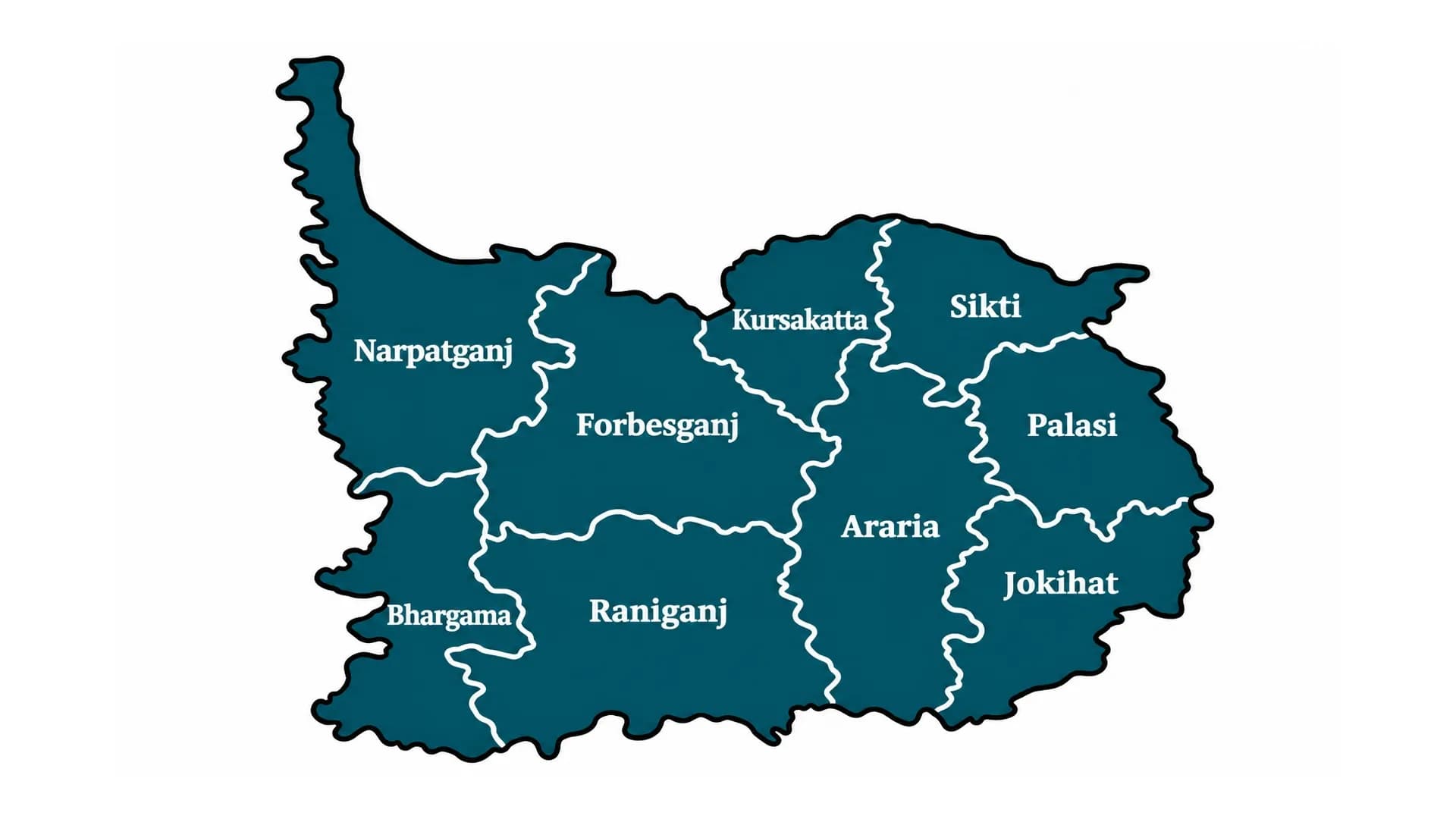
Araria
Araria is a northeastern district of Bihar situated near the Nepal border. Known for its agricultural economy, river systems and cultural diversity, the district is an important part of Purnea Division.
- Headquarters
- Araria
- Division
- Purnea Division
- Established
- 1990
- Area
- 2,830 sq km
- Population
- 2,811,569 (2011)
- Lok Sabha
- Araria
- Vidhan Sabha
- Narpatganj | Raniganj (SC) | Forbesganj | Araria | Jokihat | Sikti
Araria District, Bihar
Overview
Araria is a district located in northeastern Bihar and forms part of Purnea Division. Araria town serves as its administrative headquarters. The district is known for its agricultural economy, fertile plains, river systems and geographical proximity to Nepal. It plays an important role in the regional economy and administration of northeastern Bihar.
History and Heritage
The history of Araria is associated with the broader historical development of the Purnea region. During British rule, Araria was an important administrative subdivision. It became a subdivision in 1864 and remained part of the erstwhile Purnea district until its establishment as an independent district in January 1990.
The name Araria is commonly associated with the expression Residential Area, which was shortened to R. Area during the British period. The nearby town of Forbesganj is named after British administrator A.J. Forbes.
Geography and Administration
Araria covers approximately 2,830 square kilometres and belongs to Purnea Division. The district is located in the northeastern part of Bihar and shares an international border with Nepal.
The Kosi, Suwara, Kali, Parmar and Koli rivers are among its important river systems. The district has two subdivisions, Araria and Forbesganj, and nine administrative blocks.
Population and Demographics
According to the Census of India 2011, Araria district had a population of 2,811,569. The district recorded a population density of approximately 993 people per square kilometre, a sex ratio of 921 females per 1,000 males and a literacy rate of 53.53%.
Hindi and regional languages are used across the district. Its population includes rural agricultural communities and residents of growing urban centres.
Economy and Agriculture
Agriculture is the principal economic activity in Araria. Paddy, maize and jute are among the important agricultural products cultivated in the district.
The fertile alluvial plains and river systems support farming, while local markets and transport connections facilitate the movement of agricultural produce. Small businesses, trade and service activities also contribute to the district economy.
Political Significance
Araria has an important role in Bihar's northeastern political landscape. It has one Lok Sabha constituency, Araria.
The district has six Bihar Legislative Assembly constituencies: Narpatganj, Raniganj (Scheduled Caste), Forbesganj, Araria, Jokihat and Sikti.
These constituencies represent the district's rural and urban population in the Bihar Legislative Assembly and national Parliament.
Culture and Tourism
Araria has a cultural identity shaped by the traditions of northeastern Bihar and the adjoining Nepal region. Its communities celebrate traditional festivals and maintain regional customs, folk practices and local forms of cultural expression.
The district's rural landscape, agricultural settlements and river surroundings contribute to its regional character. Forbesganj is an important commercial and urban centre.
Education and Healthcare
Araria has government schools, colleges and educational institutions serving students from urban and rural communities. Educational facilities are distributed across its subdivisions and administrative blocks.
Government hospitals, community health centres and primary health facilities provide medical services to residents. Access to improved education and healthcare remains important for the district's development.
Transport and Connectivity
Araria is connected to other parts of Bihar through road and railway networks. Araria and Forbesganj are important transport and commercial centres.
Road connectivity supports access to neighbouring districts and the Nepal border region. Railway services connect the district with important destinations in northeastern Bihar and beyond.
Development and Urban Growth
Agricultural development, flood management, road connectivity, education, healthcare and employment generation are important development priorities for Araria.
Its proximity to the Nepal border also makes trade, transportation and cross-border regional connectivity relevant to its economic development.
Araria District Today
Araria remains an important district of northeastern Bihar because of its geographical location, agricultural production and regional connectivity. Its administrative headquarters, Araria town, and commercial centre, Forbesganj, support public services and economic activities across the district.