
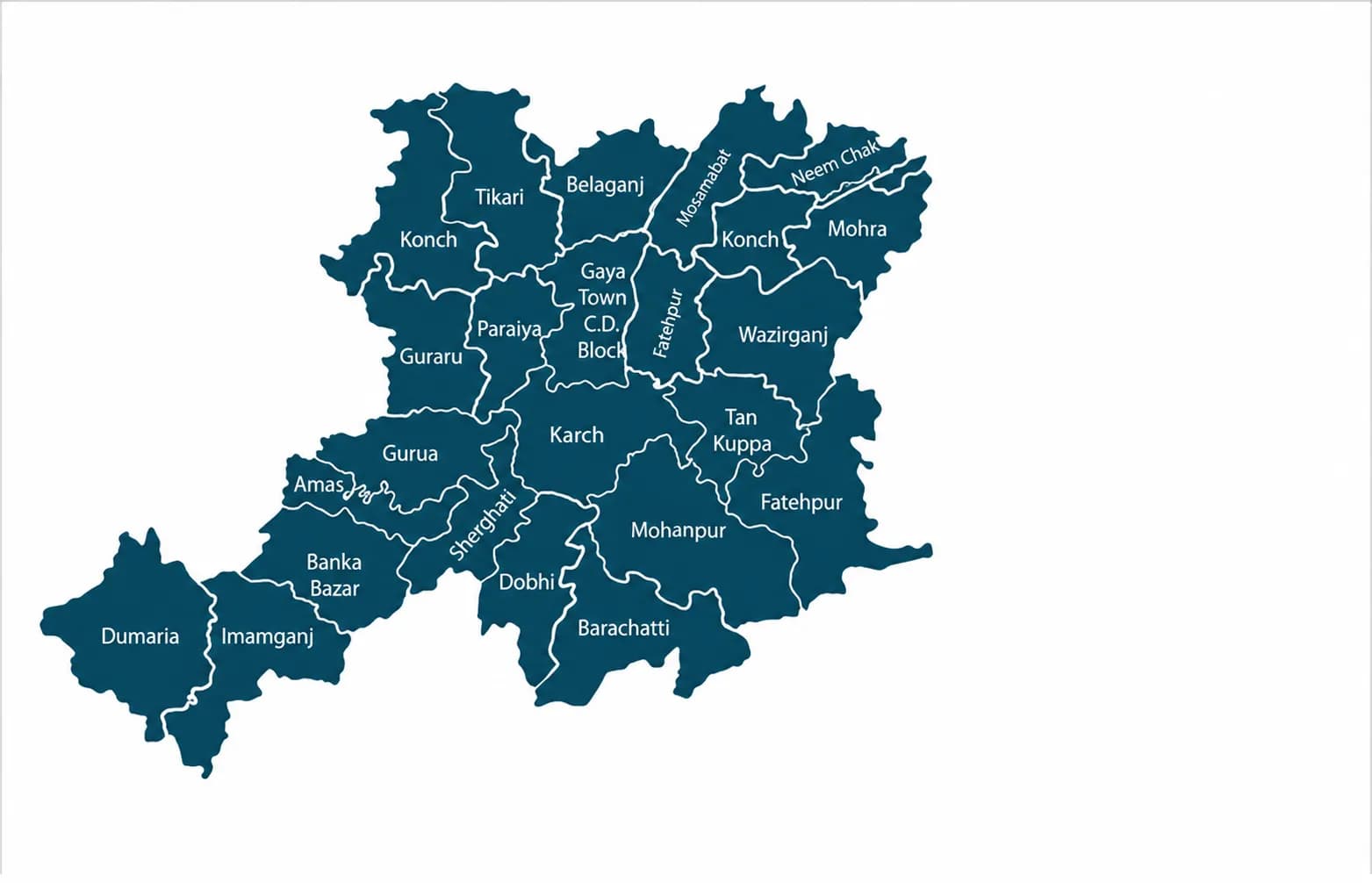
Gaya
Gaya is a historical and religious district in southern Bihar, serving as the headquarters of Magadh division and a major international pilgrimage centre.
- Headquarters
- Gaya
- Division
- Magadh Division
- Established
- 1865
- Area
- 4976 sq. km
- Population
- 4391418 (Census 2011)
- Lok Sabha
- Gaya
- Vidhan Sabha
- Gaya Town | Belaganj | Bodhgaya | Atri | Wazirganj | Imamganj | Barachatti | Sherghati | Gurua | Tikari
Gaya District, Bihar
Overview
Gaya is one of the most historically and religiously significant districts in Bihar, serving as the headquarters of the Magadh division. Located along the Phalgu River, the district combines a vibrant urban centre with extensive rural and agricultural landscapes. Its identity is shaped by ancient spirituality, Buddhist heritage, pilgrimage tourism, and regional administration.
History and Heritage
Gaya has an ancient heritage spanning millennia, deeply tied to both Hinduism and Buddhism. It is internationally renowned for Bodh Gaya, where Gautama Buddha attained enlightenment under the Bodhi Tree. The modern administrative district was constituted in 1865, carrying forward centuries of spiritual and cultural legacy.
Geography and Administration
Gaya district covers approximately 4,976 square kilometres in southern Bihar, bounded by rocky hills and traversed by rivers like the Phalgu and Mohane. Gaya serves as the district headquarters and the administrative seat of the Magadh division, managing numerous community development blocks and local governance units.
Population and Demographics
According to the Census of India 2011 district census handbook, Gaya district had a population of 4,391,418. The population comprises urban residents, semi-urban townsfolk, and rural farming communities. Hindi and Magahi are widely spoken, along with Urdu and regional dialects.
Economy and Agriculture
The local economy is heavily driven by pilgrimage tourism, commerce, education, and hospitality services. Agriculture remains vital for rural households, with paddy, wheat, pulses, and seasonal vegetables cultivated across fertile tracts irrigated by river networks and canals.
Political Significance
Gaya plays a crucial role in Bihar's political and electoral landscape. The district encompasses the Gaya Lok Sabha constituency and multiple Bihar Legislative Assembly constituencies, representing both urban and rural voters in state policy discussions.
Tourism and Cultural Attractions
Major attractions include the Mahabodhi Temple (a UNESCO World Heritage Site), Vishnupad Temple, Bodhi Tree, and sacred sites associated with ancestral Pinda Daan rituals that attract millions of pilgrims annually from across the globe.
Education and Learning
Gaya is a major educational hub in southern Bihar, hosting prestigious institutions such as the Central University of South Bihar, Gaya College, and various professional and medical training institutes serving students from across the region.
Transport and Connectivity
Gaya Junction is a major railway hub connecting the region to major cities across India, while Gaya Airport provides domestic and seasonal international air connectivity, supported by a robust network of roads and highways.
Development and Public Priorities
Key development priorities for the district include upgrading tourism infrastructure, expanding irrigation facilities, improving rural road connectivity, enhancing healthcare services, and managing sustainable urban growth.
Gaya District Today
Gaya remains a foundational pillar of Bihar's identity, beautifully bridging ancient spiritual legacies with contemporary administrative, educational, and economic prominence