Bihar INDIA Bloc Marches to Lok Bhavan, Demands CEC Gyanesh Kumar’s Resignation Over SIR Dispute
Opposition Parties Unite Over Electoral Roll Revision
The Opposition INDIA bloc in Bihar staged a protest march in Patna on Thursday, October 8, 2026, demanding the resignation of Chief Election Commissioner Gyanesh Kumar over alleged irregularities in the Special Intensive Revision (SIR) of electoral rolls.
The march brought together leaders and supporters of the Rashtriya Janata Dal (RJD), Congress, Left parties and other INDIA bloc constituents. The procession was led by RJD working president and Leader of Opposition in the Bihar Assembly, Tejashwi Yadav.
The protesters began their march from Shaheed Smarak near the Bihar Legislative Assembly and proceeded towards Lok Bhavan, the Governor’s official residence, intending to submit a memorandum to Governor Lieutenant General (Retd.) Syed Ata Hasnain.
The demonstration centred on the Opposition’s concerns about the electoral roll revision process and its demand for accountability from the Election Commission. The allegations formed part of a wider political dispute over voter-list verification and the safeguards needed to ensure that eligible voters are not excluded.
Police Barricades Halt the March
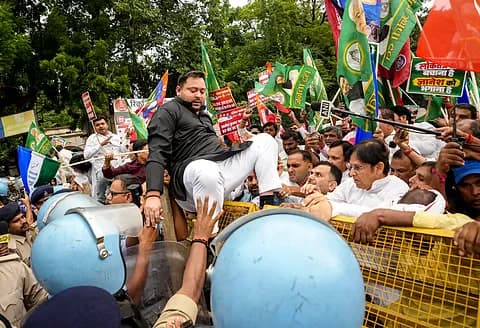
The procession was stopped near the Election Commission office, where police had deployed personnel and erected barricades to restrict the protesters’ movement.
During the confrontation, Tejashwi Yadav attempted to cross the barricades but was stopped by police. The situation became tense, with several leaders and demonstrators reportedly stumbling amid the commotion.
CPI(ML) leader and former MLA Ajit Kushwaha fainted during the incident and was taken away for medical assistance, according to the report.
Yadav accused the ruling National Democratic Alliance (NDA) of adopting what he described as a “dictatorial attitude”. He also questioned the heavy police presence, alleging that the arrangements were intended to prevent the Opposition from raising its concerns.
The police response became a central issue in the protest, with Opposition leaders arguing that their right to demonstrate should be respected.
Police Explain Action as Protest Unfolds
Patna Senior Superintendent of Police Kartikeya Sharma said Tejashwi Yadav and some other leaders were taken to Lok Bhavan to meet the Governor. Some protesters were detained for allegedly creating a disturbance, according to the police account reported by the media.
RJD MP Misa Bharti, who participated in the march, accused the police of acting in a “high-handed manner”. Her criticism reflected the Opposition’s objection to the way the gathering was handled.
The incident illustrated the competing accounts surrounding the demonstration: Opposition leaders questioned the restrictions and police conduct, while the authorities reported detentions linked to alleged disturbances.
Tejashwi Yadav Takes Aim at the Election Commission
After meeting the Governor, Yadav continued to criticise the Election Commission and the ruling alliance. He also referred to recent police action against students and alleged that Opposition leaders were increasingly being targeted.
Taking a swipe at Chief Election Commissioner Gyanesh Kumar, Yadav recited a parody of a popular children’s rhyme, accusing the CEC of attempting to give the BJP an unfair electoral advantage. These were political allegations made by the RJD leader and should not be treated as established findings.
Hundreds of INDIA bloc workers and leaders gathered outside Lok Bhavan as Yadav and a delegation met the Governor. Protesters also raised slogans against Bihar BJP president Sanjay Saraogi when he arrived at the premises.
In a separate confrontation, RJD MLC Sunil Kumar Singh was stopped by police after reportedly attempting to climb onto the bonnet of Saraogi’s vehicle.
Congress Uses Handcuffs as a Symbol
Bihar Congress president Rajesh Kumar Ram, who accompanied Yadav, arrived wearing handcuffs. He said the handcuffs symbolised his view that “democracy is in chains”.
The gesture was intended to draw attention to the Opposition’s allegations that democratic rights and dissent were being restricted. It also underscored the effort by INDIA bloc partners to present the protest as a collective challenge to the handling of the electoral roll revision process.
Vikassheel Insan Party chief and former Bihar minister Mukesh Sahni was also part of the delegation that met the Governor. Sahni said the Governor had assured the delegation that its memorandum would be forwarded to the authorities concerned. He added that the Opposition was prepared for what he described as a “long fight”.
SIR Dispute Remains at the Centre of Political Debate
The Special Intensive Revision of electoral rolls has become a point of political contention, with Opposition parties raising concerns about the process and demanding accountability from election authorities. The Election Commission’s procedures and official responses are important to assessing those concerns, including whether eligible voters face a risk of exclusion and what mechanisms are available to correct errors.
The Patna march brought these concerns into the streets, turning a dispute over electoral administration into a confrontation involving political leaders, police restrictions and competing claims about democratic rights.
The Opposition’s demand for the Chief Election Commissioner’s resignation represents its political position on the controversy. Establishing whether particular irregularities occurred requires examination of electoral records, documented complaints and responses from the relevant authorities.
For Bihar, the dispute highlights the importance of transparent voter-list revision, accessible correction procedures and public confidence in the electoral process as political parties prepare for future contests.
Related Keywords
Join the discussion