Bihar SIR Protest: Tejashwi Yadav Leads Opposition Campaign Against CEC Gyanesh Kumar
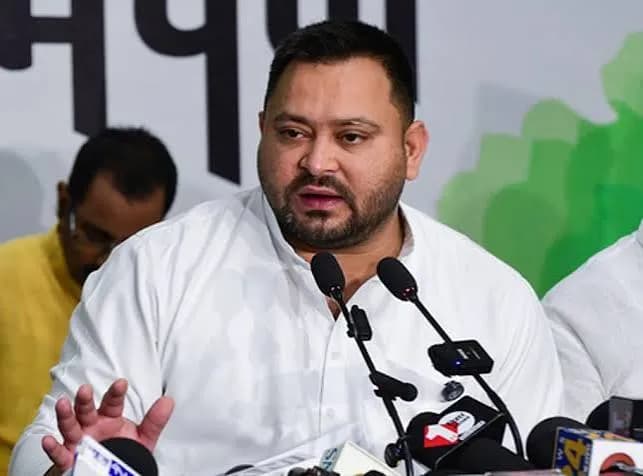
The political confrontation over the Special Intensive Revision (SIR) of electoral rolls has intensified in Bihar, with Opposition parties led by RJD leader Tejashwi Yadav organising protests and demanding action against Chief Election Commissioner Gyanesh Kumar.
The campaign has moved from statements in the Assembly and Parliament to street-level mobilisation across the state.
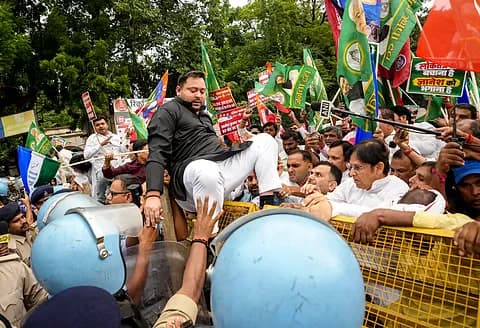
RJD announced protests at block and district levels, followed by a larger demonstration in Patna. The Opposition has alleged irregularities in the electoral-roll revision process and has demanded greater accountability from the Election Commission.
Why the Opposition Is Protesting
The central issue is the SIR exercise.
Opposition parties have raised concerns about the deletion or exclusion of voters during the electoral-roll revision process.
Tejashwi Yadav has made particularly strong allegations against Chief Election Commissioner Gyanesh Kumar, accusing him of acting in favour of the BJP-led political establishment.
These are political allegations made by the Opposition, and they should be distinguished from independently established findings.
The Election Commission’s position and official verification remain essential to evaluating individual claims.
Tejashwi Yadav’s Role
As Leader of the Opposition in Bihar and a senior RJD leader, Tejashwi has become the principal face of the campaign.
He has argued that the Opposition will not allow what it describes as the weakening of democratic safeguards.
The RJD has sought to transform the SIR issue into a broader political campaign involving voter rights and electoral transparency.
From Block Protests to Patna
The RJD announced a two-stage protest programme.
The first stage involved demonstrations at block headquarters.
The second involved district-level protests and a larger march in Patna.
The INDIA bloc has been involved in the wider mobilisation, with Opposition parties expected to participate in the Patna programme.
This structure allows the campaign to reach beyond major cities.
It also provides local party organisations with an opportunity to mobilise workers and supporters around a national electoral issue.
Why Bihar Is Particularly Sensitive
Bihar’s electoral politics is highly competitive.
The state has a history of close contests among major political alliances, making electoral-roll questions particularly sensitive.
The Opposition therefore sees the SIR debate as an issue that can influence public confidence in the electoral process.
For the ruling establishment, however, electoral-roll revision is an administrative exercise governed by election authorities.
The political disagreement arises from how the process is interpreted and whether specific voter exclusions are considered legitimate.
Election Commission’s Institutional Position
The Election Commission is a constitutional institution responsible for managing elections and electoral rolls.
The political controversy has therefore raised a broader institutional question.
Opposition parties argue that the Commission should provide greater transparency and accountability.
The ruling BJP has criticised the Opposition’s campaign and rejected allegations that the electoral process is being manipulated for political purposes.
The dispute is therefore not simply between two political parties.
It concerns public confidence in the institution responsible for conducting elections.
Why Documentation Matters
The most important part of the controversy will be the examination of individual voter cases.
Political allegations about wrongful deletion need to be supported by electoral records and verified through the appropriate administrative process.
If an eligible voter has been wrongly excluded, there are established mechanisms through which the issue can be raised.
At the same time, legitimate administrative corrections should not automatically be characterised as political manipulation.
This distinction is important for maintaining an evidence-based debate.
Opposition Strategy
For the RJD and its allies, the SIR controversy provides a common issue around which Opposition parties can mobilise.
The campaign also allows Tejashwi Yadav to position himself as the principal challenger to the ruling alliance on questions concerning democracy and electoral rights.
The effectiveness of this strategy will depend on whether the Opposition can sustain mobilisation and present verifiable evidence.
BJP’s Response
The BJP has rejected the Opposition’s allegations and criticised the protests.
The party’s argument is that the Election Commission should be allowed to perform its constitutional responsibilities without political pressure.
This has created two competing narratives.
The Opposition frames SIR as an electoral transparency issue.
The BJP frames the protests as an attempt to undermine an independent institution.
Wider Political Consequences
The SIR dispute is also influencing political relationships within Bihar.
The issue has brought RJD, Congress and other Opposition parties together for demonstrations, even as the same parties compete against each other in the MLC election.
This creates an unusual political situation.
The parties can cooperate on one issue while remaining electoral competitors on another.
What Comes Next
The next phase of the controversy will depend on several developments.
First, the Election Commission’s handling of individual voter complaints will be important.
Second, Opposition parties are likely to continue political mobilisation.
Third, the BJP will continue to defend the electoral process and challenge the Opposition’s allegations.
Finally, the issue could remain politically relevant beyond the immediate protests because voter-list integrity directly affects public confidence in elections.
For Bihar, the debate is particularly significant because elections remain one of the central arenas of political competition.
The SIR controversy has therefore evolved from an electoral-roll revision exercise into a larger political dispute over voter rights, institutional accountability and trust in the electoral system.
For Tejashwi Yadav and the RJD, it is an opportunity to mobilise the Opposition.
For the Election Commission, it is a test of how effectively it can explain and defend the revision process.
And for voters, the most important question remains whether every eligible citizen can participate in elections through a transparent and verifiable electoral-roll system.
Related Keywords
Join the discussion